
UNESCO World Heritage Site
Call this number
Google Map in English
Google Maps in Japanese
Whenever we have any extra time during a Kyoto trip, we make the trip out to Uji. Everyone talks about the matcha there, and it’s genuinely good, but for us the real reason to go is Byodo-in.
The temple started out as a Fujiwara family villa — Fujiwara no Michinaga, one of the most powerful court nobles of the Heian period, had it built as a retreat along the Uji River in 998. His son, Fujiwara no Yorimichi, later converted it into a Buddhist temple in 1052, and the following year he added the building everyone actually comes to see: the Phoenix Hall.
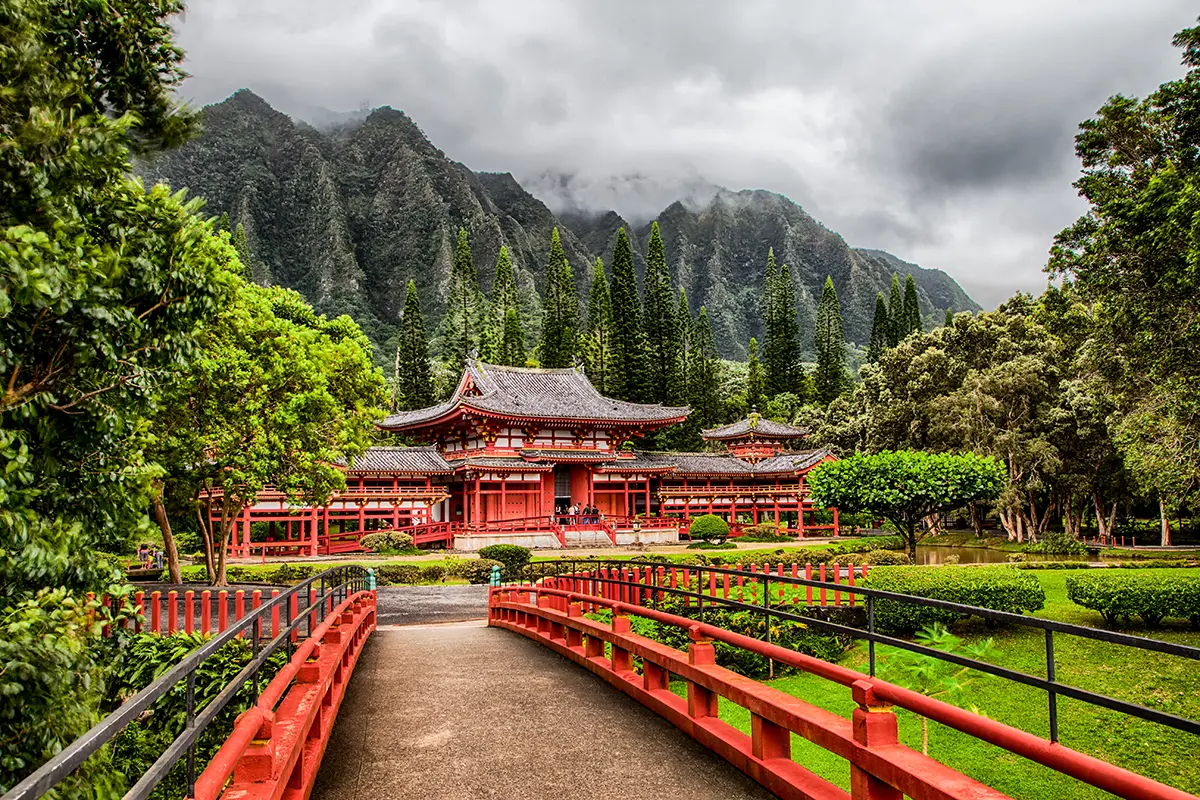
What gets us every time is the reflection. The Byodo-in’s hall sits right at the edge of a pond, and when the water’s calm, the building doubles itself perfectly on the surface — the wood, the color, the two golden phoenixes on the roof, all mirrored back. It’s the kind of thing photos never quite capture. You can look at a hundred pictures of it beforehand and it still catches you off guard standing there in person.
What struck me most, actually, was thinking about how deliberate that effect must have been. Whoever designed Byodo-in wasn’t just building a temple — they were designing an image, calculating exactly how the structure would sit against the water and the mountains behind it, centuries before anyone could sketch it out digitally or even guess how the pond would settle. The whole thing was built to represent Amida Buddha’s Pure Land, a kind of paradise made visible on earth, and standing in front of it, that intention still comes through. It’s not hard to see why people found it convincing enough to call it heaven on earth.
Inside sits a large Amida Buddha statue carved by Jocho, one of the most celebrated sculptors of the Heian period. He used a joined-woodblock technique that let him build large, refined statues out of multiple pieces instead of a single trunk, which was a real shift in how Buddhist statues were made in Japan. Around the hall, 52 small bodhisattva carvings are mounted near the ceiling, each one different, each riding a cloud, each holding a different instrument. Some of the originals are kept up close in the temple’s underground museum, the Hoshokan, so it’s worth budgeting time for that too rather than just walking the grounds and leaving.
If any of this looks familiar even before you’ve been, there’s a reason: the Byodo-in’s Phoenix Hall has been on the back of the ten-yen coin since the 1950s, and the phoenix statues themselves appear on the current 10,000-yen note. It’s probably one of the most reproduced buildings in the country, which is a strange thing to realize while standing in front of the real one.
Byodo-in became a UNESCO World Heritage Site in 1994, and it’s easy to see why once you’re there — not just because of the hall itself, but the garden around it. It’s designed in the old Jodo style, meant to mirror that same idea of paradise, with the pond and the surrounding hills doing as much work as the architecture.
If you’re staying in Kyoto and haven’t made it out to Uji yet, it’s an easy day trip, and honestly, the combination of Byodo-in and a stop for matcha afterward makes for one of the more relaxed afternoons you can build into a Kyoto itinerary. We keep going back, and it hasn’t gotten old yet. Each visit, we notice some new detail we missed before — a carving, an angle of light on the pond, a small design choice that must have taken the original builders years to get exactly right.
Submission successful. You will receive a confirmation email, shortly.