
Google Map in English
Google Maps in Japanese
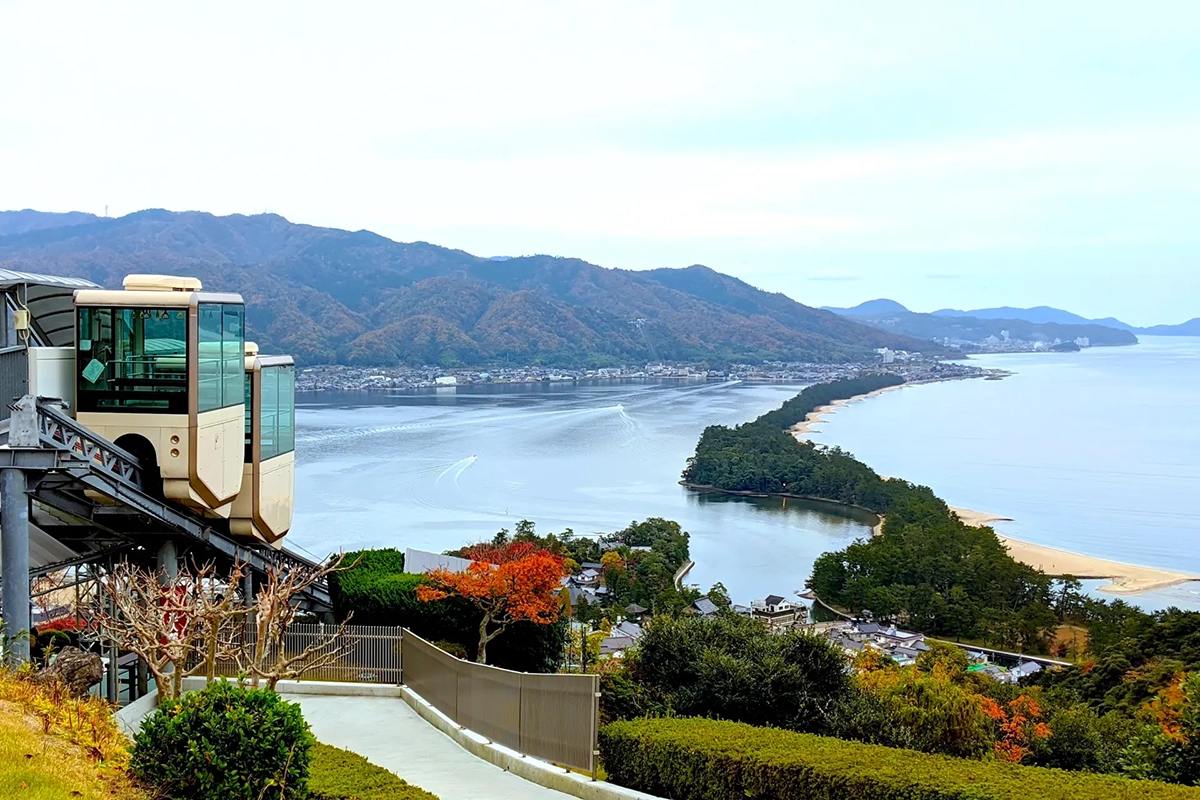
Amanohashidate Viewland sits on the top of Mt. Monju, overlooking one of Japan’s most famous scenic spots, Amanohashidate. From the observatory, you get a wonderful panoramic view of the long, pine-covered sandbar stretching across Miyazu Bay.
The view from Mt. Monju is known as “Hiryukan,” or “view of the flying dragon,” because Amanohashidate looks like a dragon rising toward the sky. The traditional way to appreciate the view is “matanozoki,” or “looking through the legs.” By bending over and looking at Amanohashidate upside down between your legs, the sandbar appears to stretch upward toward the heavens. It is a fun tradition, and one that we have enjoyed ourselves.
Amanohashidate Viewland is more than just an observation point. There are several small attractions and rides, including a Ferris wheel, making it a place that can be enjoyed by visitors of all ages. To reach the top of Mt. Monju, you can take either the chairlift, which takes about six minutes, or the monorail, which takes about eight minutes. The monorail is also available for wheelchair users.
We had a wonderful time at Amanohashidate Viewland during our visit. After walking across the famous sandbar, we took the chairlift up to Amanohashidate Viewland. The chairlift ride was also part of the experience. As we slowly climbed Mt. Monju, the view gradually opened up, making us even more excited to see what awaited us at the top.
We also had lunch at the restaurant at Amanohashidate Viewland. We enjoyed a local fish dish while looking out over Amanohashidate and Miyazu Bay. The food was delicious, but the spectacular view made the meal even more memorable. There are not many places where you can enjoy a local meal while looking down on one of Japan’s most beautiful scenic spots. It was a beautiful place to pause, enjoy the scenery, and appreciate how peaceful Amanohashidate that felt.
Amanohashidate is located in northern Kyoto Prefecture on the Sea of Japan, and it feels quite different from the busy tourist areas around Kyoto City. It takes roughly two hours to get there from Kyoto, depending on how you travel, but the change of scenery is well worth the trip.
We stayed at Hotel Kitanoya, which is located on a hillside overlooking Amanohashidate. Our room had a beautiful view of the sandbar stretching across the bay. With scenery like that right outside our window, it was tempting to spend more time in the room than we had planned!
We stayed in Amanohashidate for three days, and the slower pace was a welcome change from our usual busy routine. The town becomes very quiet in the evening, with many businesses closing relatively early. One night, after most of the town had gone quiet, we found a food truck near the station selling hot takoyaki. It was a simple thing, but enjoying hot takoyaki outside on a quiet evening became one of our favorite memories from the trip.
The local train service also reminded us that we were in a much smaller community than Kyoto City. The trains were small, sometimes consisting of only one or two cars, and they did not run very frequently. We quickly learned that missing a train could mean a fairly long wait for the next one.
One evening, we saw our train arriving and hurried toward the station, afraid that we would miss it. We were out of breath when we reached the train, but the driver smiled and waved us aboard. He had apparently seen us coming and waited for us. It was a small kindness that we still remember.
Amanohashidate has an especially personal meaning for me because my grandfather was from this area. I have fond memories of visiting Amanohashidate Viewland with him when I was a child.
I still remember him teaching me how to look at Amanohashidate upside down through my legs. He told me that when you look at it this way, the sandbar resembles a bridge connecting heaven and earth. It is a simple trick, but as a child, I thought it was magical.
Returning to Amanohashidate Viewland as an adult brought back those memories. Standing at the same viewpoint and seeing the same landscape after so many years was a special experience.
This time, we took the chairlift to the top of Mt. Monju. The view from the observatory is impressive not only because of Amanohashidate itself, but also because you can see the surrounding mountains and Miyazu Bay from above. Take some time to look around rather than simply taking a photograph and moving on.
There is also an observation deck, a shop selling local souvenirs, and a restaurant where you can enjoy a meal while taking in the view.
During our stay, we also made a point of trying some of the local restaurants. We enjoyed Ryugu Soba, as well as meals at Tondaya and Taikyoro Agura. Each had its own character, and trying local food was an important part of experiencing the area.
Amanohashidate is often visited as a day trip, but we recommend staying overnight if you have the time. Once the day-trippers leave, the atmosphere changes completely. The area becomes quiet and peaceful, giving you a chance to enjoy the scenery at a much slower pace.
For us, Amanohashidate Viewland was more than just another beautiful destination. It was a place where we could reconnect with family memories, enjoy the scenery, eat local food, and simply slow down for a few days.
And, of course, standing at the top of Mt. Monju and looking down at Amanohashidate brought back that childhood memory of my grandfather showing me the “flying dragon” upside down through my legs. Some views become even more special when they come with a story.ant to wake up from. It’s one of those places that gets you to slow down, look around, and just soak in the moment—a perfect break from our everyday rush.
Submission successful. You will receive a confirmation email, shortly.