Quintessence
カンテサンス


Call this number
Google Map in English
Google Maps in Japanese
Quintessence sits inside the Garden City Gotenyama complex in Shinagawa, a part of Tokyo most tourists skip entirely. That’s part of what makes finding a table here so strange — you’re not walking past neon signs or fighting crowds, you’re just showing up to a quiet office-district building for what’s considered one of the hardest reservations in the world. The restaurant has held three Michelin stars for years, all under one chef, Shuzo Kishida, who opened the place in 2006 and has never left the kitchen.
Kishida trained under Pascal Barbot at L’Astrance in Paris, and you can see that training in how he cooks now, even though what comes out of his kitchen doesn’t look much like traditional French food. He took the technique and rebuilt it around Japanese ingredients, Japanese water, Japanese produce — less an import than a translation.
There’s no menu to look at before you sit down. Quintessence runs on what’s called “menu carte blanche”: you get handed a blank sheet of paper, and the kitchen simply cooks whatever came in fresh from the market that day. Kishida has described his approach around three ideas — ingredient, flame, seasoning — which sounds almost too simple until you taste what it produces. Instead of piling on technique, most dishes center on one ingredient pushed to its best possible version, cooked with precise heat and very little else.
A handful of dishes at Quintessence come up again and again in reviews. The goat’s-milk bavarois is probably the closest thing to a signature — light, barely sweetened, built entirely around milk from local farms. Foie gras and lily bulb, a mildly sweet root vegetable, show up often too, and there’s a meringue dessert paired with ice cream that plays more with texture than sugar. Nothing about the plating is loud. If anything, it’s almost stripped down, like the kitchen trusts the ingredient enough to leave it alone.
One rule says a lot about how seriously this place takes that idea: no photography in the main dining room at Quintessence. Private rooms are the exception. In a city where every plate usually ends up on someone’s phone before it’s touched, banning cameras is a real statement — you’re there to eat, not to document.
There’s also a strange little pop-culture footnote here. Quintessence’s food inspired the 2019 drama Grand Maison Tokyo, and Kishida himself worked with the production to help design the dishes served in the show’s fictional restaurant. If you watched that series before knowing the real place existed, it’s a fun bit of overlap — not unlike how we stumbled onto Tour d’Argent through Hanzawa Naoki.
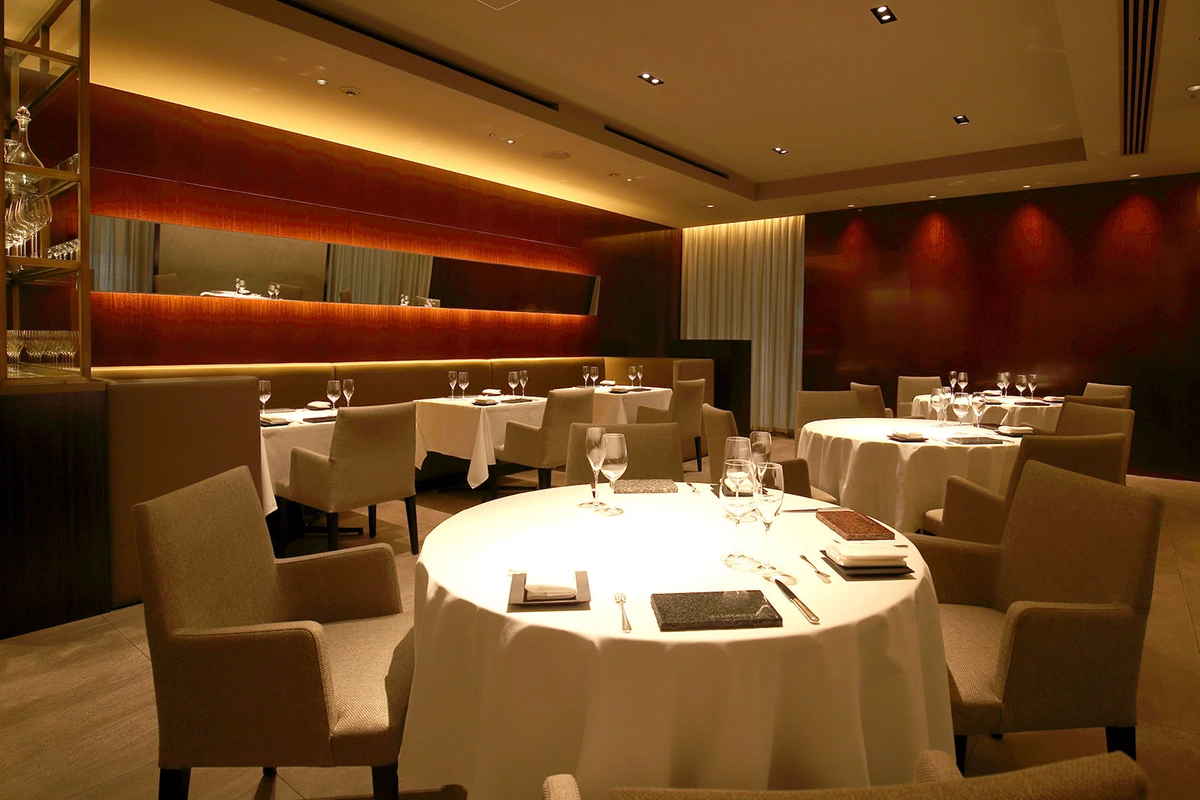
The dining room matches the food: plain walls, no unnecessary decoration, an open kitchen so you can watch the cooking happen a few feet away instead of picturing it from behind a closed door. Staff keep their distance without disappearing, and the sommelier is worth talking to — the wine list runs deep, and pairing it well with a menu you don’t get to pick takes real skill.
Getting a reservation is its own challenge. People who’ve tried both say it’s harder to book a table here than at L’Astrance in Paris, the very restaurant that trained Kishida in the first place. That difficulty has become part of the restaurant’s reputation, though it’s not something the place seems to chase. It just keeps cooking the same way it has for almost twenty years, and the recognition has followed rather than led.
If you do get in, don’t go expecting spectacle. Quintessence isn’t interested in dazzling anyone with plating or novelty. It wants to show you one ingredient at its absolute peak, course after course — and for most people who’ve eaten there, that ends up sticking with them longer than anything flashier would.
Submission successful. You will receive a confirmation email, shortly.