
UNESCO World Heritage Site
Call this number
Google Map in English
Google Maps in Japanese
Yakushi-ji sits in Nara, and it’s one of those temples that manages to feel both ancient and still very much alive. It’s a UNESCO World Heritage Site, but unlike some historical sites that feel more like museums, Yakushi-ji still functions as a working temple, with monks, rituals, and visitors taking part in traditions that go back over a thousand years.
Emperor Tenmu founded the temple in the 7th century, praying for the recovery of his wife, who would later become Empress Jito. She recovered, and the temple’s fortunes ended up tied closely to the rise of the Fujiwara clan in the centuries that followed.
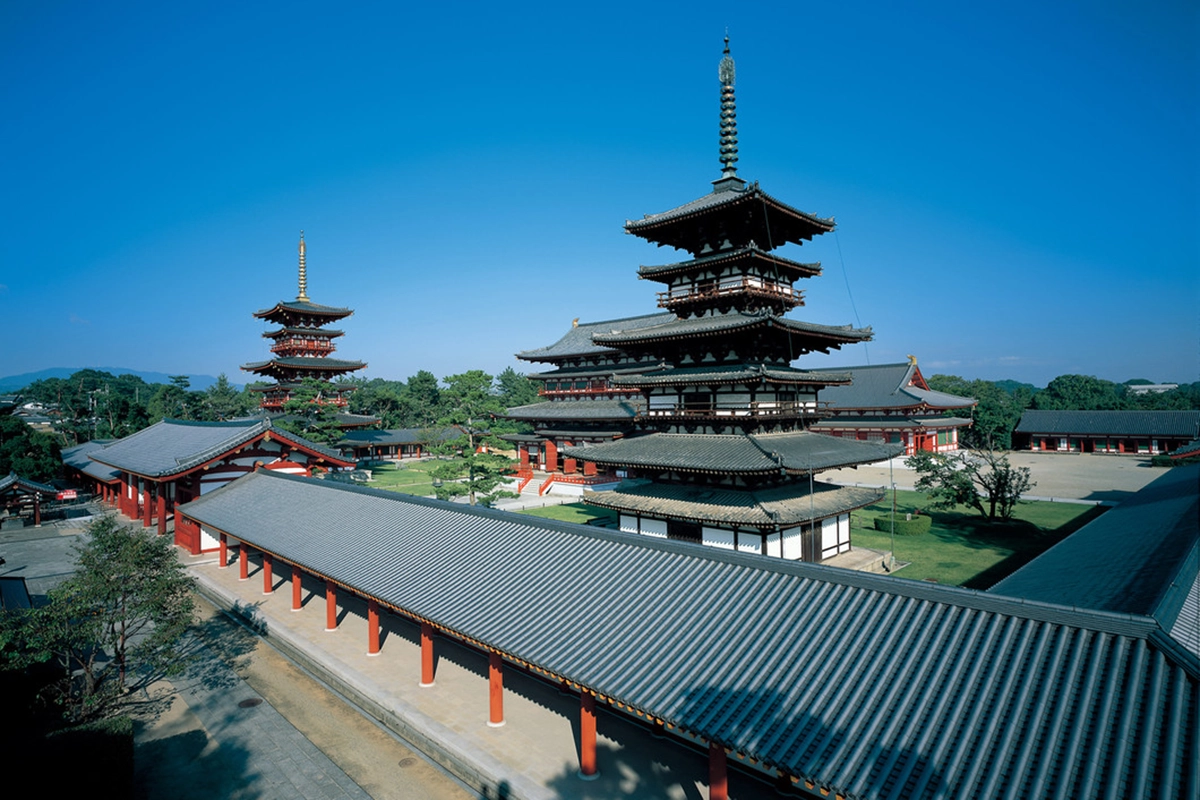
The East Pagoda is the temple’s centerpiece — over 30 meters tall, five stories, and the oldest wooden pagoda still standing in Japan. Look closely and you’ll notice the roofline seems to have more layers than a typical five-story structure; that’s an optical effect from smaller decorative roofs tucked between the main ones, a design choice that gives the whole tower a rhythm as you look up at it. The carvings across its surface have survived centuries of Japanese weather, which is its own kind of small miracle.
Inside the Main Hall, rebuilt in the 1970s after the original was lost, sits the Yakushi Buddha, believed to hold healing power. The statue has a quiet, settled presence that’s hard to describe until you’re standing in front of it — not dramatic, just steady, like it’s been waiting there far longer than you have.
The West Pagoda gets less attention than its eastern twin, but it shouldn’t. Built in the 8th century, slightly smaller, and carrying the same intricate carving work, it completes a pair that together says something about how much effort went into this place from the very beginning.
None of it came easily, either. Fires, earthquakes, and war have all taken their toll on the temple over the centuries, and much of what stands today has been rebuilt or restored at some point. That history of loss and rebuilding is part of what makes walking the grounds feel different from visiting a temple that’s simply been left untouched — this one has clearly been fought for.
One thing worth doing while you’re there: Yakushi-ji is known locally as “the temple of oshakyo,” or sutra copying, and it’s been running this practice daily since 1968, when the head priest at the time started it as a way to raise funds for rebuilding the temple. Visitors are welcome to sit at low tables inside the sutra-copying hall, grind their own ink, and trace the characters of the Heart Sutra with a brush, following a printed guide underneath the paper.
You don’t need any prior experience or religious background — the monks walk first-timers through the whole process, including a short purification ritual before you sit down. It typically takes about an hour, and once you’re finished, your sutra is kept and enshrined within the temple, meant to remain there indefinitely. It’s a strange, quiet way to spend part of a temple visit, slower and more deliberate than simply walking through and taking photos, and it leaves you with a different kind of souvenir than the usual omamori or postcard.
Depending on the season, the grounds themselves shift dramatically. Cherry blossoms take over in spring, and by autumn the whole complex turns red and gold, framing the pagodas in a way that changes the entire feel of a visit depending on when you go.
Nara as a city adds its own layer to the experience. It was Japan’s first permanent capital, and wandering between temples with deer roaming freely through the parks gives the whole area an odd, storybook quality that’s hard to find elsewhere in the country.
Yakushi-ji rewards slowing down. Between the pagodas, the Buddha hall, and the chance to sit and copy a sutra by hand, it’s a temple that asks a little more of you than a quick walkthrough — and gives back more for it too.
Submission successful. You will receive a confirmation email, shortly.